

.png)







There's a lot of noise around AI in creative work right now. Most of it focuses on speed and cost reduction. Some of it is genuine. Most of it papers over a more important question: where in the process does AI actually belong, and where does it do damage if you let it in too early?
For us, the answer is precise. Every branding project moves through four stages: discovery, positioning and messaging, creative direction, and identity development. AI touches exactly one of them. Understanding why requires understanding what each stage actually demands.
Stage one: Discovery and positioning
The first two stages involve no AI. That's a deliberate choice, not a default.
Discovery is extraction work. It means pulling out what a founder actually believes about their market, their competitors, and the problem their product solves – often before they've found the language to articulate it clearly themselves. It means reading what's unsaid in a positioning conversation, identifying where a company's self-perception diverges from how their buyers experience them, and forming a view on what they actually need to own in the minds of the people they're selling to.
That work depends on conversation, experience, and the kind of judgement you build across dozens of projects in technical B2B markets. It requires someone who has seen how cybersecurity companies talk about trust differently from how energy infrastructure companies do, and who understands which positioning moves work at Series A versus Series C. It is not something you can compress or delegate.
Positioning and messaging follow the same logic. The output – a positioning statement, value proposition, messaging pillars, and tone of voice – needs to be strategically defensible and commercially grounded. Getting there is an iterative, human process.
Stage two: Creative direction
AI enters at the creative direction stage, and that placement is deliberate.
By this point, strategic intent is fixed. We know what the brand needs to do commercially, what it needs to communicate, and how the positioning shapes both the visual and verbal identity. The question now is what that could actually look like – which visual territories are worth exploring, which directions carry the right energy, and which ones feel interesting but collapse under scrutiny.
This is the stage where idea volume and speed of iteration matter. It's also the stage where the cost of a wrong creative direction is highest, because developing a direction fully takes significant time and, for clients, significant trust. The ability to test and evaluate before committing is valuable here.
What AI actually does at this stage
We use AI to expand idea volume before committing to directions, generate early visual textures we can react against and develop, and add a second layer of critique alongside our own thinking. It helps us surface connections across references and concepts at a scale that would otherwise take days to cover manually, and it lets us stress-test directions that feel right intuitively but haven't been examined closely enough.
The framing that matters: AI is a thinking tool at this stage. Not a production tool. It doesn't generate work that goes to a client. It generates material we interrogate, respond to, and use to sharpen the thinking before development begins.
A practical example: Secure Agentics
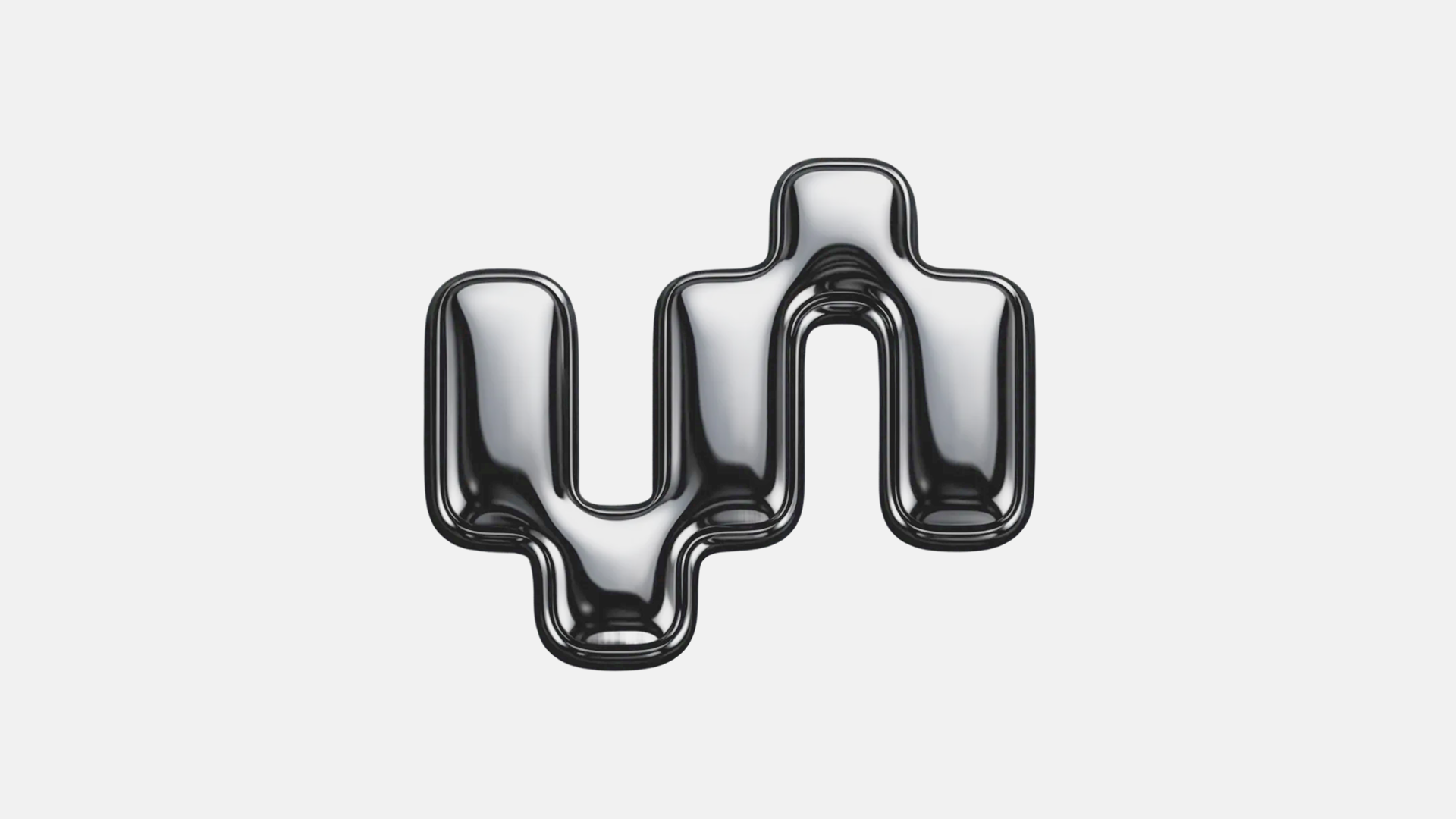
Our work on Secure Agentics demonstrates this well. We wanted to explore ferrofluid motion as a visual direction for the brand – fluid, reactive, technically credible, and fitting for a company operating in agentic AI security. The concept felt like it had the right properties. The question was whether it would actually hold up visually and strategically at the level the brief required.
Traditionally, testing and visualising a motion concept at that level of fidelity means engaging an animation studio, significant production budget, and weeks of iteration before you have enough to evaluate whether the territory is worth pursuing. For most projects, the economics mean the concept doesn't get tested. You make a judgement call and find out later whether it held up.
Using AI inside our creative process, we ran that test rapidly – not as a finished piece of work, but as a proof of concept. Enough to evaluate whether the visual direction was coherent, whether it matched the strategic intent, and whether it gave us a broad enough creative territory to work within. It did. The direction opened a more ambitious range of creative possibilities than a conventional process would have reached, and it did so without adding time or budget to the project.
The result wasn't speed for its own sake. It was better creative decision-making with lower risk.
Stage three: Identity development
When identity development begins, AI steps back entirely.
Mark-making, system-building, typographic decisions, colour logic, the relationship between visual elements – this is craft work, made against what the brand needs to do commercially. Every decision needs to resolve. The exploratory phase is closed. What we're doing now is building something complete and usable, with the rigour and precision that a brand system requires to actually function in the hands of a team.
This stage can't be accelerated without compromising the output. It shouldn't be.
The boundary that doesn't move
Throughout all of this, there are lines that don't shift. AI doesn't define positioning. It doesn't make strategic decisions. It doesn't produce final creative outputs. Those remain human – not because of principle, but because the quality of those decisions determines whether the work succeeds commercially.
What AI provides is more considered exploration at the stage where exploration matters most. It doesn't replace taste or judgement. It creates more room for both.
Define how your company is understood

Insights on B2B Branding